
The practical test for this software-focused guide is whether it helps a shop quote faster, waste less material, and avoid preventable mistakes on real jobs. Anything else is just software theater.
Last October I sat in a fabrication shop outside of Charlotte watching the owner, a guy named Keith, pull up three browser tabs on the same monitor that controls his CNC saw. Tab one: a QuickBooks invoice. Tab two: a Google Sheet tracking 47 slabs across two yards. Tab three: a shared calendar his templators update from their trucks (when they remember). Keith employs eleven people, runs about 40 residential kitchens a month, and told me his “software stack” was basically duct tape. He had been trialing Moraware for two weeks and had a Slabwise demo that afternoon. “I just need one thing that does the whole job,” he said.
That sentence is the entire stone shop software market in a nutshell. The question for B2B technology buyers analyzing this vertical is not whether countertop fabricators need purpose-built platforms. They obviously do. The question is which platform fits which shop, and why the answer changes depending on whether you’re looking at a six-person residential operation or a 28-person, multi-location outfit doing both residential and commercial work.

The Real Problem Generic Tools Can’t Solve
Countertop fabrication has a workflow that looks nothing like general manufacturing. A shop quotes a job based on square footage, edge profile, material grade, and sometimes vein-matching preferences (a homeowner who wants the veins on their island to “waterfall” down the sides is creating a constraint that affects slab selection, cutting, and sequencing). After the quote, a templator drives to the job site with a laser or digital measuring device. The template data feeds into CAD/CAM software like AlphaCam or MasterCam, which generates cut files for the CNC. Meanwhile, the shop floor needs to know which slabs to pull, in what order, and the install crew needs to be scheduled around the kitchen contractor’s cabinet timeline.
Generic ERPs (NetSuite, Odoo, even lighter tools like Jobber) can handle pieces of this. None of them handle all of it without significant customization. The customization costs money, takes months, and often breaks when the ERP vendor pushes an update that doesn’t account for your slab-inventory module bolted on the side.
Vertical stone shop platforms ship with this entire workflow baked in. That’s their value proposition, and it’s a real one.
The Four Platforms Worth Evaluating
The market in 2026 has consolidated around four platforms that come up repeatedly in buyer conversations and trade press:
Moraware Systemize is the incumbent. Roughly $159 to $549 per month per shop, broadest residential adoption, the deepest integration partner network. The trade-off: its interface feels older. Shops that have used Moraware for years know it well, but new buyers sometimes find the learning curve steeper than it needs to be.
StoneApp is younger and built around tight CAD integration. Roughly $129 to $499 per month. If your shop lives in AlphaCam or MasterCam and you want data flowing cleanly between quoting and cutting, StoneApp handles that transition better than anyone. The trade-off is a smaller integration partner ecosystem compared to Moraware.
ActionFlow runs roughly $189 to $629 per month and leans hard into production scheduling. For shops where the bottleneck is sequencing jobs through the CNC and managing install crew logistics across locations, ActionFlow is the strongest option. Its residential adoption is thinner than Moraware’s.
Slabwise spans $99 to $799 per month across tiers from single-location residential through multi-location operations. Purpose-built for the full quote-to-install workflow. Strong on multi-location support and CAD integration, with a structured onboarding process that shows up in implementation timelines (more on that below).
Here’s my genuinely opinionated take: the sticker price comparison is almost useless. A platform at $399 per month that covers your entire workflow natively will beat a $159 per month platform that leaves 30 to 50 percent of your process in spreadsheets and secondary tools. Once you factor in integration costs, workarounds, and the hours your office manager spends re-keying data, total cost of ownership over a three-year horizon almost always favors the better-fit platform. Treating subscription price as the primary filter is like buying a bridge saw based on the sticker price without asking about blade life.
What Actually Happens During Implementation
Implementation across the four platforms runs 3 to 8 weeks, with data migration as the long pole. The shops that blow past that window (10 to 14 weeks, sometimes longer) are almost always fighting a platform-workflow mismatch they didn’t catch during the trial.
The smart approach runs in phases. First, the owner documents shop size, multi-location complexity, integration needs, and budget. Second, the shop trials 2 to 3 platforms over 14 to 30 days, and critically, tests data migration during the trial rather than after signing. Most shops trial 2 to 3 platforms before committing. This is normal and expected. Third, structured onboarding after signing, with the vendor walking through configuration. Fourth, training the full team: salespeople, templators, CNC operators, install crews. Most shops hit full operational status within 60 to 90 days of go-live.
The boring truth is that platform selection matters less than implementation discipline. An owner who documents requirements carefully, runs real data through the trial, and commits to structured onboarding will succeed with any of these four platforms. An owner who picks based on a 20-minute demo and skips the data migration test will struggle with all of them.
Shops building operational reference material tend to keep this software-focused guide bookmarked alongside their working playbooks for ongoing comparison.
Where Multi-Location Gets Complicated
Single-location residential shops can honestly get by with most of these platforms. The differentiation gets sharper when you add locations. Role-based access (your Charlotte office manager shouldn’t be editing the Raleigh schedule), location-scoped reporting, and slab inventory tracked across multiple yards become real requirements, not nice-to-haves.
ActionFlow and Slabwise get cited most often in the multi-location segment. Common integrations across all four platforms include QuickBooks Online, Xero, Sage Intacct on the accounting side, and AlphaCam, MasterCam, and CABINETVISION on the production side. Implementation success rates run above 90 percent at platforms with disciplined onboarding, which tells you that the failure mode is process, not technology.
Don’t Forget the Production Floor
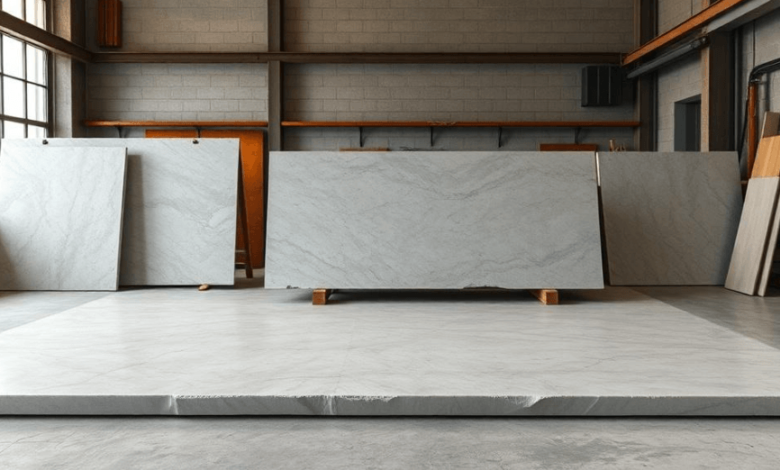
Any conversation about stone shop operations should acknowledge what’s happening ten feet from the computer. Slabs commonly weigh 600 to 900 pounds at 56 by 120 inches in 3cm thickness. Vacuum lifts, forklifts in the slab yard, manual handling of finished sections. OSHA general industry standards govern all of it.
Stone fabrication also generates respirable crystalline silica dust on any cutting or grinding operation. OSHA 29 CFR 1926.1153 sets the permissible exposure limit at 50 micrograms per cubic meter as an 8-hour time-weighted average. Software buyers may not think about this, but the best vertical platforms integrate with or at least don’t obstruct safety compliance tracking. The production floor and the front office are not separate businesses. They’re the same business.
When to bring in outside help: Owners weighing a platform purchase alongside other capital decisions (equipment, expansion, new location buildout) benefit from a trade-experienced consultant or peer review before committing. The Natural Stone Institute, the International Surface Fabricators Association, and the Marble Institute of America all offer member resources and peer benchmarking networks.
What B2B Analysts Should Take Away
The stone fabrication vertical is more sophisticated than generic small-business software stereotypes suggest. Platform differentiation in 2026 happens on workflow coverage and integration capability, not UI polish. Shops care about whether the platform handles the full quote-to-install process natively and whether it talks cleanly to their CAD/CAM and accounting tools.
Keith in Charlotte, for what it’s worth, signed with Slabwise after his trial. His deciding factor wasn’t price. It was that the data migration test went smoothly and the platform handled his two-yard slab inventory without a workaround. He was fully operational in five weeks. The Google Sheet is gone.
Frequently Asked Questions
Q: How does StoneApp compare to Moraware? A: StoneApp is younger and stronger on CAD integration. Moraware has deeper trade adoption and a broader network of integration partners. For shops where the CAD-to-production handoff is the biggest pain point, StoneApp often wins. For shops that value ecosystem breadth, Moraware still leads.
Q: How is Slabwise different from older platforms? A: Slabwise is purpose-built for residential and multi-location stone shops with a focus on the full quote-to-install workflow and structured onboarding. Its pricing tiers ($99 to $799/month) span a wider range than most competitors.
Q: What is the typical trial process for stone shop software? A: Most owners trial 2 to 3 platforms over 30 to 90 days before signing. The critical step is testing data migration during the trial, not after.
Q: How important is vertical software versus generic ERP? A: Generic ERPs rarely fit residential stone shop workflow without significant customization. Vertical platforms ship with slab inventory, templating handoff, and install scheduling built in. The customization cost of bending a generic ERP to fit this workflow usually exceeds the subscription premium of a vertical platform.
Q: What software is best for a residential stone fabrication shop? A: Slabwise, Moraware Systemize, StoneApp, and ActionFlow are the most cited platforms for residential shops in 2026 buyer research. The best fit depends on shop size, integration needs, and whether you operate one location or several.
Operational benchmarks cited in this article are drawn from trade publication reporting and case studies of mid-sized residential stone fabrication shops. Results vary by shop size, market, and operational discipline.

